Collision with the Moon: Falcon 9 Rocket Upper Stage to Hit Satellite Surface
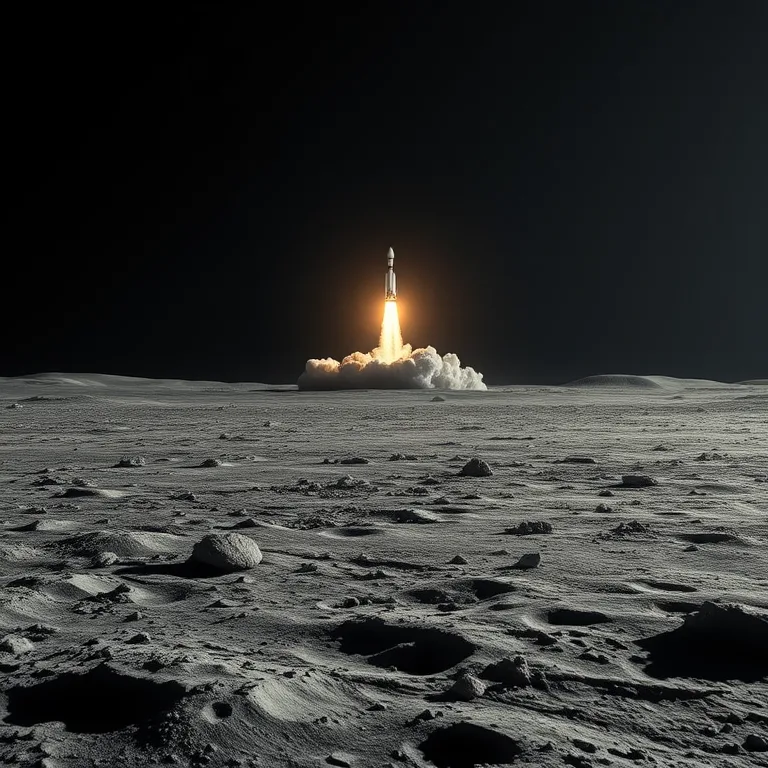
The upper stage of the Falcon 9 rocket, belonging to the company SpaceX, is expected to collide with the surface of the Moon on August 5. According to data from NASA's Center for Near Earth Object Studies (CNEOS), the object is moving at a speed of approximately 8,700 kilometers per hour.
Details of the Object and Trajectory
The collision is the result of the trajectory of a rocket part launched in January 2025 as part of a joint US and Japanese mission to transport lunar modules and scientific equipment. The rocket stage in question is the size of a five-story building and weighs at least 4,000 kilograms.
Astronomer Bill Gray, who first identified the trajectory, predicts that the impact will occur near the Einstein crater in the sunlit part of the Moon. According to his calculations, the result of the collision will be a new crater with a diameter of over 17 meters.
Scientific Potential and Observations
Although the event poses no danger to Earth, it offers a unique opportunity for scientific research. Jimmy Russell, a spokesperson for NASA's Space Operations Service, stated that the agency will track the object for educational purposes and subsequently observe the impact site.
Dr. Matt Botwell, an astronomer from the University of Cambridge, explains that due to the lack of atmosphere and the Moon's weak gravity, the collision will be extremely impressive. He expects that upon impact, a dust cloud will rise to an altitude of over 50 kilometers, scattering debris with a mass of approximately one million kilograms.
Large telescopes in North and South America, as well as NASA's Lunar Reconnaissance Orbiter and the South Korean probe Danuri, are prepared to track the event. Scientists hope that observing the dust cloud will help refine lunar impact models and reveal information about the composition of the subsurface material.
The Problem of Space Debris
The collision also highlights the growing problem of space debris. According to the European Space Agency (ESA), there are approximately 54,000 objects larger than 10 centimeters moving in space. Dr. Botwell warns of the risk of an uncontrollable chain reaction as the number of objects launched into orbit continues to increase.
Comments (0)